Ichimoku Cloud — Complete Trading System
Updated How we review
Overview
The Ichimoku Cloud (Ichimoku Kinko Hyo) is a complete trading system in one indicator, identifying trend direction, support/resistance, momentum, and trade signals using five lines and a cloud. It is one of the most complete entries in our indicator guide library, best applied on daily charts across forex and crypto markets. Incorporate Ichimoku signals into your broader trading strategies for multi-factor confirmation before entering a position.
How It Works
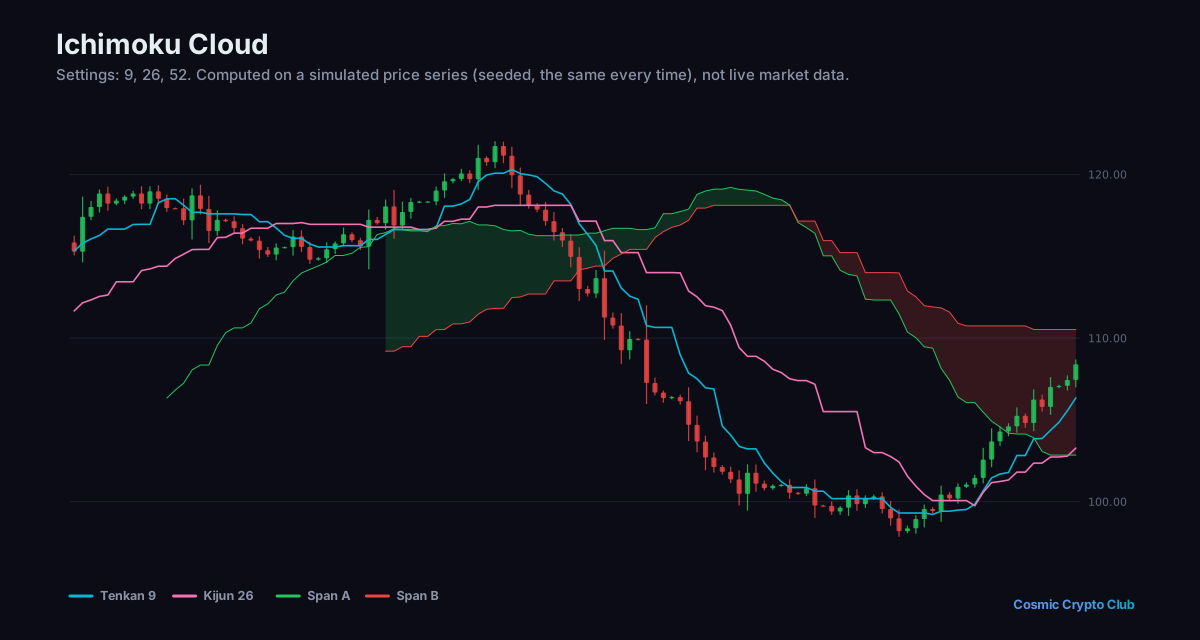
Ichimoku consists of Tenkan-sen (9-period midpoint), Kijun-sen (26-period midpoint), Senkou Span A (midpoint of Tenkan + Kijun, plotted 26 ahead), Senkou Span B (52-period midpoint, plotted 26 ahead), and Chikou Span (close plotted 26 periods back). The cloud (Kumo) is the area between Span A and Span B.
Key Signals
- Price above a green cloud = strong uptrend; below a red cloud = strong downtrend.
- Tenkan crossing above Kijun = bullish signal (TK cross).
- A thin cloud suggests weaker support/resistance; a thick cloud is harder to break.
- Chikou Span above price confirms bullish momentum.
Common Mistakes
- Changing the default settings (9, 26, 52) without understanding why they were chosen.
- Using Ichimoku on timeframes below 1 hour — it was designed for daily charts.
- Taking TK cross signals when price is inside the cloud (low probability).
More Trend Indicators
Parabolic SAR — Stop and Reverse
Parabolic SAR (Stop and Reverse) plots dots above or below price to indicate trend direction and potential reversal points — it is one of the simplest trend-following indicators to use. Combine it with the <a href="/academy/indicators/adx" class="text-primary hover:underline">ADX</a> to help filter out low-quality signals in ranging markets. It also doubles as a dynamic trailing stop; read our <a href="/guides/use-stop-loss-orders" class="text-primary hover:underline">stop-loss guide</a> for best practices on protecting your capital. Explore more trend tools in our full <a href="/academy/indicators" class="text-primary hover:underline">indicator guide library</a>.
WMA — Weighted Moving Average
The Weighted Moving Average assigns linearly increasing weight to more recent prices, making it more responsive than the <a href="/academy/indicators/simple-moving-average" class="text-primary hover:underline">SMA</a> while maintaining a straightforward calculation. WMA is popular among <a href="/market/forex" class="text-primary hover:underline">forex</a> traders who need faster trend signals without the complexity of exponential smoothing. Compare it with the <a href="/academy/indicators/exponential-moving-average" class="text-primary hover:underline">EMA</a> and other moving averages in our <a href="/academy/indicators" class="text-primary hover:underline">indicator guide library</a> to choose the best fit for your strategy.
Exponential Moving Average (EMA)
The Exponential Moving Average gives more weight to recent prices, making it more responsive to new information than the <a href="/academy/indicators/simple-moving-average" class="text-primary hover:underline">SMA</a> while still smoothing out noise. EMA crossovers are a cornerstone of many <a href="/strategies" class="text-primary hover:underline">trading strategies</a>, from scalping to <a href="/strategies/trading-styles/swing-trading" class="text-primary hover:underline">swing trading</a>, across every asset class. Use the EMA on a professional <a href="/tools/platforms/tradingview" class="text-primary hover:underline">charting platform</a> to fine-tune pullback entries and trend-following setups. Browse our full <a href="/academy/indicators" class="text-primary hover:underline">indicator guide library</a> to learn how the EMA integrates with momentum and volume tools.
VWAP — Volume Weighted Average Price
VWAP calculates the average price weighted by volume throughout the trading session — it is the institutional benchmark that separates winners from losers on every intraday chart. Understanding VWAP is essential for trading <a href="/market/stocks" class="text-primary hover:underline">stocks</a> and <a href="/market/crypto" class="text-primary hover:underline">crypto</a> at the same levels the big players target. Combine VWAP with tools like the <a href="/academy/indicators/volume-profile" class="text-primary hover:underline">Volume Profile</a> for a more complete picture of institutional activity. Set it up on <a href="/tools/platforms/tradingview" class="text-primary hover:underline">TradingView</a> and pair it with your favourite momentum indicator for high-probability intraday setups.
Explore Related
Talk it through with other traders
Ask questions and discuss what you've learned in the Cosmic Crypto Club Discord. It's free, and so are the courses in the Hub with a Discord sign-in.