Covered Call Calculator
Analyse a covered call strategy by calculating static and if-called returns, breakeven price, premium income, and whether shares will be assigned at expiration.
Total P&L
$1,750.00
Stock P&L
$1,300.00
Premium Income
$450.00
Assigned?
No
Breakeven
$140.50
Max Profit
$1,950.00
Static Return (to expiration)
3.1%
If-Called Return (to expiration)
13.45%
How the Covered Call calculator works
A covered call is shares you own plus a call option sold against them. The calculator adds the premium received to the gain or loss on the shares at expiration; if the price ends above the strike the shares are sold at the strike, which caps the profit. It also shows the breakeven price and two returns on your cost basis for the period up to expiration: the static return, if the call expires unexercised, and the if-called return, if the shares are sold at the strike.
Premium income = Premium x Shares
Stock P/L = (lower of Expiration price and Strike - Cost basis) x Shares
Total P/L = Stock P/L + Premium income
Breakeven = Cost basis - Premium
Max profit = (Strike - Cost basis + Premium) x Shares
Static return = Premium / Cost basis
If-called return = (Strike - Cost basis + Premium) / Cost basis
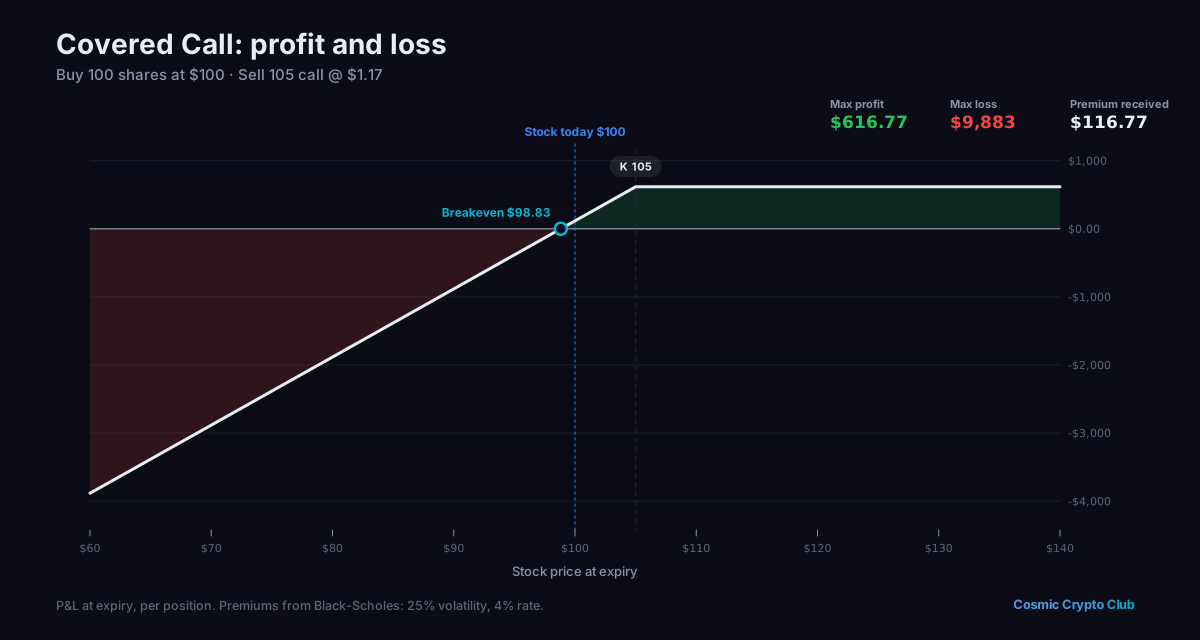
Worked example
You own 100 shares bought at $50, sell one $55 call for a $2 premium, and the stock is at $53 at expiration.
- Premium income: $2 x 100 = $200.
- Stock P/L: the price ends below the strike, so ($53 - $50) x 100 = $300.
- Total P/L: $300 + $200 = $500.
- Breakeven: $50 - $2 = $48; max profit: ($55 - $50 + $2) x 100 = $700.
- Static return: $2 / $50 = 4%; if-called return: $7 / $50 = 14%.
The position makes $500, the call expires unexercised and you keep the shares; had the stock closed above $55, the profit would have been capped at $700.
Frequently asked questions
What is the difference between static return and if-called return?
Static return is the premium as a percentage of your cost, earned if the call is not exercised. If-called return adds the gain from selling the shares at the strike.
Are the returns annualised?
No. They are returns for the period up to expiration. Brokers such as Fidelity quote annualised versions, which multiply the same figure by 360 divided by the days to expiration.
What happens if the stock finishes above the strike?
The call is exercised and the shares are sold at the strike price. The profit stops at the maximum, strike minus cost basis plus the premium, however high the stock goes.
More Options calculators
More tools in the Hub
Premium opens the Hub's Analytics section: market data, research, radars, screeners, macro, calculators and backtesting. The website and the Discord stay free.