Vertical Spread Calculator
Analyse bull call, bear put, bull put, and bear call vertical spreads. Calculate max profit, max loss, breakeven, net debit or credit, and risk-reward ratio.
Buy a lower-strike call, sell a higher-strike call. A debit spread that profits when the underlying rises.
Net Debit
$2.00
Max Profit
$300.00
Max Loss
$200.00
Breakeven
$102.00
Risk : Reward
1 : 1.5
Return on Risk
150%
Total Cost
$200.00
Strike Width
$5.00
How the Vertical Spread calculator works
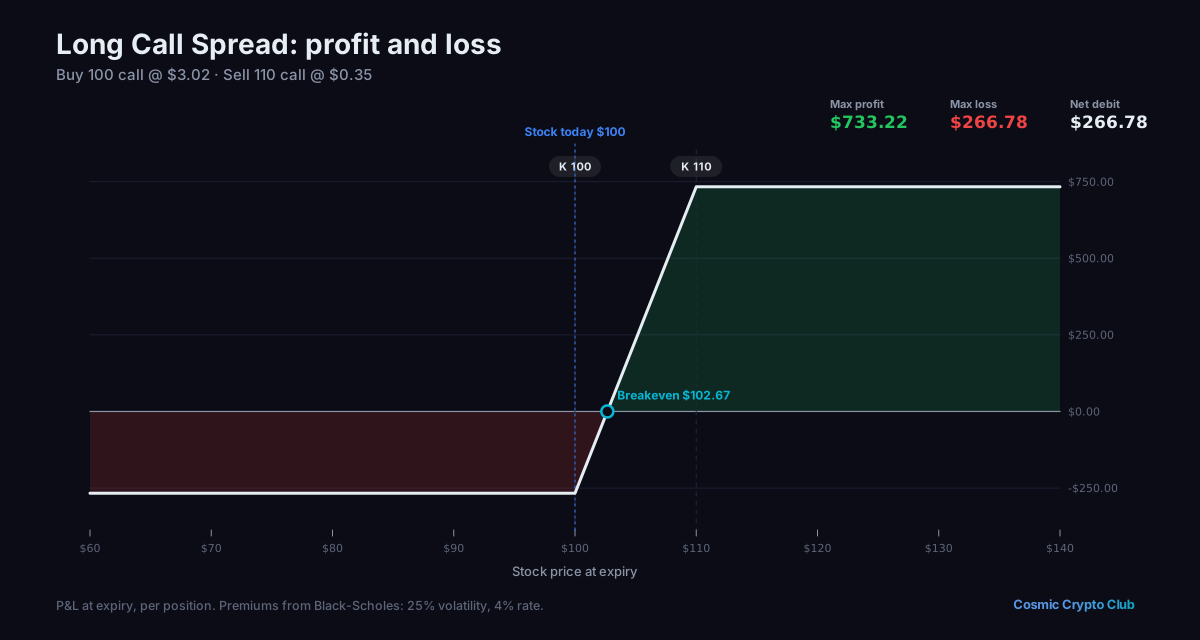
A vertical spread buys one option and sells another of the same type and expiration at a different strike. The calculator takes the two strikes and premiums and works out the net debit or credit, the maximum profit, the maximum loss and the breakeven at expiration for the four standard spreads. Debit spreads (bull call, bear put) pay to open and can lose only that payment; credit spreads (bull put, bear call) collect a premium and can lose the strike width minus that premium.
Debit spread: Net debit = Bought premium - Sold premium
  Max profit = (Strike width - Net debit) x Contracts x 100; Max loss = Net debit x Contracts x 100
  Breakeven = Bought strike + Net debit (bull call) or Bought strike - Net debit (bear put)
Credit spread: Net credit = Sold premium - Bought premium
  Max profit = Net credit x Contracts x 100; Max loss = (Strike width - Net credit) x Contracts x 100
  Breakeven = Sold strike - Net credit (bull put) or Sold strike + Net credit (bear call)
Worked example
A bull call spread: buy the $100 call for $4 and sell the $105 call for $2, 1 contract.
- Net debit: $4 - $2 = $2 per share, $200 in total.
- Max profit: ($5 width - $2) x 100 = $300.
- Max loss: the debit, $200.
- Breakeven: $100 + $2 = $102.
- Return on risk: $300 / $200 = 150%, shown as Risk : Reward 1 : 1.5.
The spread costs $200, breaks even at $102 and can make up to $300; the matching bull put spread (sell the $105 put for $4, buy the $100 put for $2) collects $200, risks $300 and breaks even at $103.
Frequently asked questions
What is the difference between a debit spread and a credit spread?
A debit spread costs money to open because the option bought is dearer than the option sold; that cost is the most it can lose. A credit spread pays a premium up front, which is the most it can make.
How is the maximum loss on a credit spread worked out?
It is the distance between the two strikes minus the net credit, times 100 per contract. The bought option stops the loss from growing beyond the strike width.
Where is the breakeven on each spread?
Bull call: bought strike plus the net debit. Bear put: bought strike minus the net debit. Bull put: sold strike minus the net credit, and bear call: sold strike plus the net credit.
More Options calculators
More tools in the Hub
Premium opens the Hub's Analytics section: market data, research, radars, screeners, macro, calculators and backtesting. The website and the Discord stay free.