ATR Stop Loss Calculator
Place a stop loss a multiple of the average true range from your entry, size the position for the amount you want to risk, and trail it with the chandelier exit.
Initial Stop
95.00
Stop Distance
5.00 (5.00%)
Position Size (units)
100.00
Position Value ($)
$10,000.00
Chandelier Exit
102.50
Chandelier Locks In
2.50 per unit
Move a stop only in the trade's favour: once the chandelier exit is above the initial stop (below it for a short), it becomes the stop, and it never moves back.
How the ATR Stop Loss calculator works
Average true range (ATR) measures how far a market typically moves in one bar. The calculator places the initial stop a multiple of ATR away from the entry, sizes the position so that a stop-out loses only the amount you choose to risk, and works out the chandelier exit: a trailing stop hung a multiple of ATR below the highest high since entry (above the lowest low for a short).
Initial stop = entry - k x ATR (long), entry + k x ATR (short)
Position size = amount to risk / (k x ATR)
Chandelier exit = highest high since entry - c x ATR (long), lowest low since entry + c x ATR (short)
True range = max(high - low, |high - previous close|, |low - previous close|); ATR = its average, usually over 14 bars
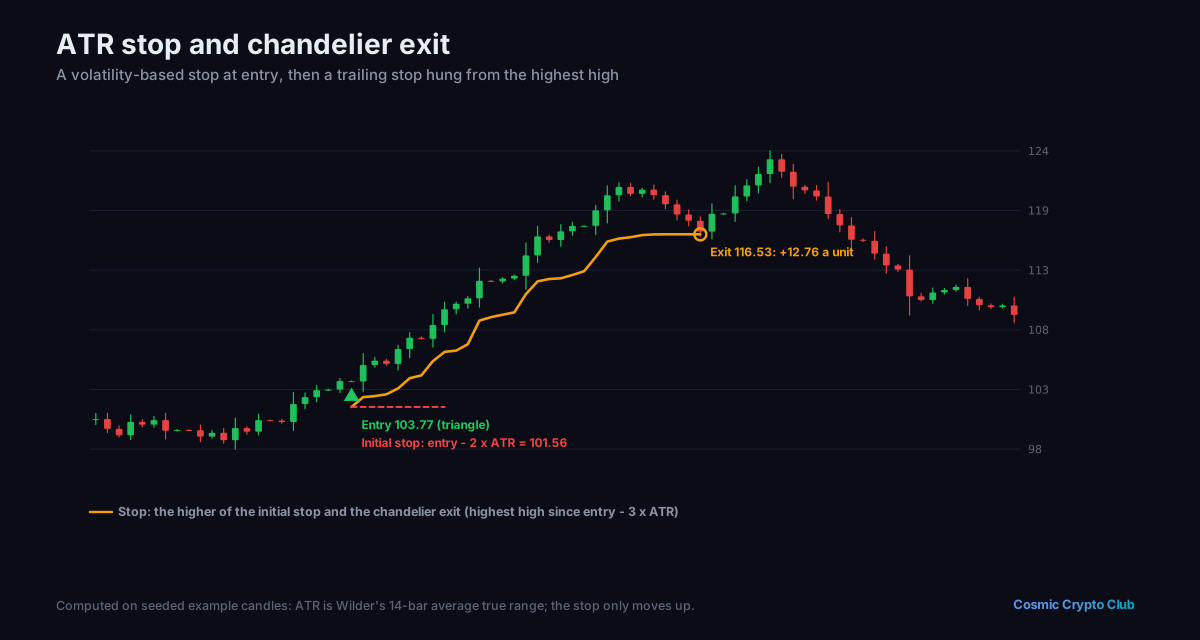
Worked example
A long at 100.00 when the 14-bar ATR is 2.5000, with a 2 x ATR stop, a 3 x ATR chandelier exit and $500 to risk.
- Initial stop: 100.00 - 2 x 2.5000 = 95.00, 5% below the entry.
- Position size: $500 / 5.0000 = 100 units, a position of $10,000.
- The price rallies and the highest high since entry is 110.00: chandelier exit = 110.00 - 3 x 2.5000 = 102.50.
- The stop moves up from 95.00 to 102.50. The trade can no longer lose: it locks in 2.5000 a unit, $250 on 100 units.
A 2 x ATR stop at 95.00 sizes the trade at 100 units for a $500 risk; once the high reaches 110.00, the chandelier exit at 102.50 locks in $250.
Frequently asked questions
What is ATR?
Average true range, J. Welles Wilder's measure of volatility. Each bar's true range is the largest of the high minus the low, the high minus the previous close and the previous close minus the low; ATR averages it, usually over 14 bars. Charting platforms show it as an indicator.
Why base a stop on ATR?
It adapts the stop to the market's current volatility. A quiet market gets a tighter stop and a volatile one a wider stop, so ordinary noise is less likely to stop you out, and the position size shrinks automatically when the stop is wide.
What is the chandelier exit?
A trailing stop developed by Chuck LeBeau, hung from the highest high since entry at a multiple of ATR, classically 3 x ATR from the highest high of the last 22 bars. It only moves in the trade's favour, so it follows a trend and gives back a set amount of volatility before exiting.
Which multiplier should I use?
There is no single right value. A smaller multiple stops out more often with smaller losses; a larger one survives more noise but loses more each time. Test the multiple on the market and timeframe you trade before relying on it.
More Risk & Trade Planning calculators
More tools in the Hub
Premium opens the Hub's Analytics section: market data, research, radars, screeners, macro, calculators and backtesting. The website and the Discord stay free.