Futures Tick Value Calculator
Work out a futures contract's tick value, point value and notional value, and a trade's profit or loss in ticks and money, with 28 CME Group contracts and Eurex's index futures built in, and any other contract by its specs.
Tick Value
€25.00
per contract, for a 1 move
Point Value
€25.00
per contract, for a move of 1.0
Notional Value
€1,000,000.00
€500,000.00 per contract
Move in Ticks
150
Profit or Loss
€7,500.00
Before fees. Built-in contract specs were read from the exchanges' own contract pages in November 2026; the prices filled in when you pick a contract are only an example. Calendar spreads and off-exchange trades can use smaller ticks than the order book. For any other contract, choose Custom and enter the point value and tick size from the exchange's contract specifications.
How the Futures Tick Value calculator works
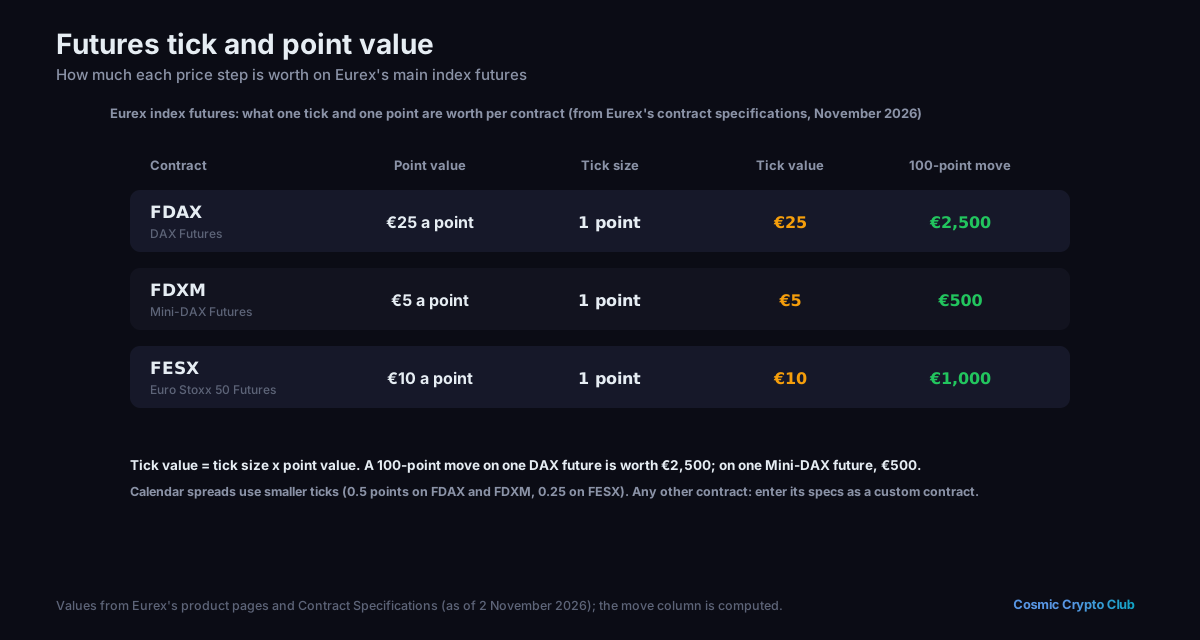
A futures price moves in fixed steps called ticks, and each contract has a point value: the money gained or lost per contract when the price moves by 1.0. The calculator multiplies the two to give the tick value, works out the contract's notional value, and turns a move from entry to exit into ticks and a profit or loss for the number of contracts you hold. 28 CME Group contracts (E-mini and Micro index, crude oil, natural gas, metals, Treasury, currency, bitcoin, ether and grain futures) and Eurex's DAX, Mini-DAX and Euro Stoxx 50 futures are built in, with specs read from the exchanges' own contract pages in November 2026; for any other contract, choose Custom and enter its point value and tick size from the exchange's contract specifications.
Tick value = tick size x point value
Notional value = price x point value x contracts
Move in ticks = (exit price - entry price) / tick size
Profit or loss = (exit - entry) x point value x contracts (reversed for a short)
Worked example
A long of 2 DAX futures (FDAX, Eurex: €25 per index point, tick 1 point) bought at 20,000 and sold at 20,150; the prices are only an example.
- Tick value: 1 point x €25 = €25.00 per contract.
- Notional value: 20,000 x €25 = €500,000.00 per contract, €1,000,000.00 for 2.
- Move: 20,150 - 20,000 = 150 points, which is 150 ticks.
- Profit: 150 x €25 x 2 = €7,500.00 before fees.
- The same 150-point move on Mini-DAX futures (€5 a point) would make €1,500.00 on 2 contracts.
Each point on the DAX future is worth €25 a contract, so a 150-point rise on 2 contracts makes €7,500.00, on a position worth €1,000,000.00.
Frequently asked questions
What is a tick in futures trading?
The smallest price step the exchange allows for a contract. On Eurex's DAX future the order book moves in steps of 1 index point; other contracts use fractions such as 0.25, 0.01 or 1/32.
What is the difference between tick value and point value?
Point value is the money per contract for a 1.0 move in the price; tick value is the money for one tick. When the tick is 1 point they are the same; when the tick is 0.25 points, the tick value is a quarter of the point value.
Why does the notional value matter?
It is the full size of the exposure. You only post margin, a fraction of the notional, but profit and loss follow the notional value, so a small move in the price is a large move against the margin.
Where do I find a contract's tick size and multiplier?
On the exchange's contract specifications page for that product. Spreads between delivery months and trades arranged off the order book can use smaller ticks than the order book itself.
More Risk & Trade Planning calculators
More tools in the Hub
Premium opens the Hub's Analytics section: market data, research, radars, screeners, macro, calculators and backtesting. The website and the Discord stay free.