Kelly Criterion Calculator
Calculate the share of your account the Kelly criterion says to risk per trade from your win rate and win/loss ratio, with half and quarter Kelly alongside.
Kelly Fraction
25.00%
Edge per Trade
0.38R
Average result in units of the amount risked
Risk at Half Kelly
$1,250.00
| Fraction | Risk per Trade | Amount at Risk | Typical Growth per Trade |
|---|---|---|---|
| Full Kelly | 25.00% | $2,500.00 | 4.675% |
| Half Kelly | 12.50% | $1,250.00 | 3.503% |
| Quarter Kelly | 6.25% | $625.00 | 2.045% |
"Risk per trade" is the share of the account you would lose if the stop is hit. Typical growth is the geometric average per trade if the win rate and ratio hold exactly; real results vary, which is why most traders use half Kelly or less.
How the Kelly Criterion calculator works
The Kelly criterion gives the share of your account to risk on each trade that makes the account grow fastest over many trades, given your win rate and how big the average win is compared with the average loss. The calculator shows full Kelly and the half and quarter fractions most traders use instead, with the typical growth per trade each one gives.
Kelly fraction f* = p - (1 - p) / b
p = win rate; b = average win / average loss (the payoff ratio)
Edge per trade = p x b - (1 - p), in units of the amount risked (R)
Typical growth per trade at fraction f = e^(p ln(1 + f b) + (1 - p) ln(1 - f)) - 1
Worked example
A system that wins 55% of the time, with an average win 1.5 times the average loss, on a $10,000 account.
- p = 0.55, 1 - p = 0.45, b = 1.5.
- Kelly fraction: 0.55 - 0.45 / 1.5 = 0.55 - 0.30 = 0.25, so full Kelly risks 25% of the account, $2,500, on each trade.
- Edge: 0.55 x 1.5 - 0.45 = 0.375R, an average gain of 0.375 times the amount risked per trade.
- Typical growth per trade: 4.675% at full Kelly, 3.503% at half Kelly and 2.045% at quarter Kelly.
- Half Kelly keeps 75% of full Kelly's growth rate while risking half as much on each trade.
Full Kelly says 25% a trade, far more than most traders risk; half Kelly (12.5%) keeps about three quarters of the growth with much smaller swings.
Frequently asked questions
What does the Kelly criterion tell you?
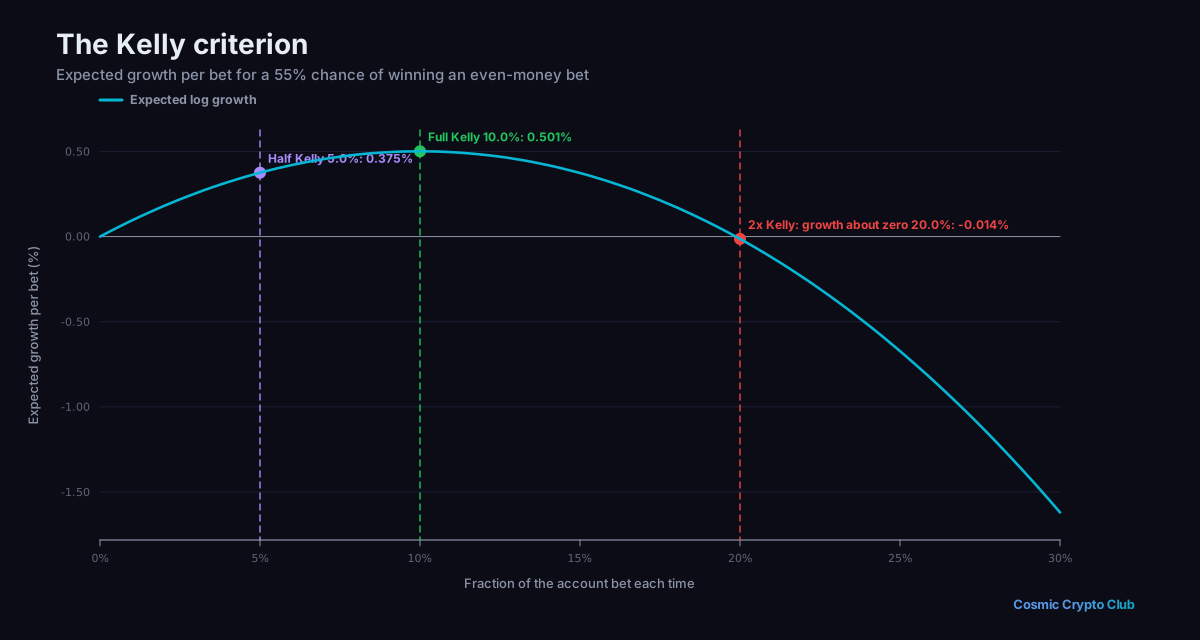
It gives the fraction of capital to risk on each bet or trade that maximises the long-run growth rate, if the win rate and payoff ratio you enter are exactly right. Risking more than that lowers growth and raises the drawdowns; risking twice the Kelly fraction gives roughly zero growth.
Why do traders use half Kelly or less?
The inputs are estimates from past trades and are usually too optimistic. Overestimating them leads to over-betting, which costs growth and brings deep drawdowns. A fraction of Kelly gives up a little growth for far smaller swings and more room for error.
What if the Kelly fraction is negative?
Then the system has no edge with those numbers: on average each trade loses money, and no position size makes it profitable.
Is the Kelly fraction my position size?
No. It is the amount at risk, what you lose if the stop is hit. The position size is that amount divided by the distance to the stop, which the position size calculator works out.
More Risk & Trade Planning calculators
More tools in the Hub
Premium opens the Hub's Analytics section: market data, research, radars, screeners, macro, calculators and backtesting. The website and the Discord stay free.